How to Effectively Light Art in a Luxury Home
Beautiful artwork can completely change a room. But even an incredible piece can fall flat when the lighting isn’t right.
Lighting art is about much more than pointing a fixture at a painting. The intensity, beam angle, color temperature and quality of the light can all change what you see. And with today’s lighting technology, we can go even further—adjusting the character of white light itself to bring out subtle colors and details in both the artwork and the surrounding interior.
For designers and homeowners, that opens up some pretty exciting possibilities.
Start With the Artwork, Not the Fixture
Every piece of art interacts with light differently.
A heavily textured oil painting may benefit from directional light that reveals its depth and brushwork. A photograph behind glass requires careful fixture placement to minimize glare and reflections. Sculpture may look completely different depending on the direction and angle of the light.
That means there isn't one perfect "art light."
Fixture placement, beam spread and aiming should be considered in relation to the size, location, material and viewing angle of the artwork. Adjustable fixtures can be particularly valuable because artwork rarely stays in exactly the same place forever.
A well-designed system gives homeowners and designers some flexibility when the collection evolves.
Color Temperature Can Completely Change What You See
Color temperature is one of the most noticeable variables in art lighting.
Measured in Kelvin (K), lower color temperatures create warmer light, while higher temperatures produce a cooler appearance.
A warm 2700K light might make reds, browns, golds and warm woods feel especially rich. Move toward 3000K or 3500K and whites may appear cleaner while blues and greens can become more apparent. Cooler light can give contemporary artwork a very different personality than a warmer source.
Neither is automatically "correct."
The goal is to choose a color temperature that works with the artwork and the interior around it.
That's where tunable-white lighting has become particularly interesting. Instead of committing a fixture to one color temperature, advanced LED lighting can allow the color temperature to be adjusted. Current residential lighting technologies can offer very broad ranges of white light, giving designers considerably more freedom than traditional fixed-temperature LEDs.
You can actually stand in the finished room, look at the art and decide what feels right.
Color Rendering Matters Just as Much
Two light sources can both say "3000K" and make the same painting look surprisingly different.
Why?
Because color temperature doesn't tell us everything about how a light source renders color.
You've probably heard of CRI, or Color Rendering Index. High-quality architectural lighting commonly offers a CRI of 90 or greater, which can provide much more accurate color reproduction than lower-quality sources.
But lighting technology has moved beyond looking at CRI alone.
The lighting industry now uses more sophisticated measurements, including TM-30, to evaluate qualities such as color fidelity, gamut and shifts in individual hues. These measurements give lighting professionals a much better picture of what a light source will actually do to the colors within a room.
For artwork, that matters.
You don't want a carefully chosen blue suddenly looking dull, or a beautiful skin tone in a portrait becoming slightly unnatural because the light source isn't reproducing that portion of the spectrum particularly well.
Then There's Vibrancy
This is where modern lighting gets really interesting.
Some advanced LED sources can do more than change color temperature. They can alter the spectral makeup—or "recipe"—of white light while maintaining the same apparent color temperature.
That can change how saturated certain colors appear.
Think about walking through an art gallery where a painting suddenly seems to have more depth. Reds may feel richer. Blues can become more pronounced. Subtle differences in fabrics, stone, wood and artwork can become easier to see.
In other words, you aren't necessarily changing the color of the light. You're changing how that white light interacts with color.
Recent lighting research is digging even deeper into this subject. The Illuminating Engineering Society has explored how spectral tuning and TM-30 color-rendering characteristics can influence the perceived saturation of fine art, particularly at the relatively low light levels often required for conservation.
That's a big leap from choosing between "warm white" and "cool white."
What About Adding Actual Color?
Full-spectrum and multi-channel LED technology can also produce colored light.
For residential art, we'd use that ability carefully.
There are certainly situations where introducing a subtle hue can complement contemporary art, sculpture or a dramatic architectural installation. But most of the time, the goal isn't to turn someone's art collection into a nightclub.
It's to reveal what's already there.
The most sophisticated systems give designers the freedom to experiment while still allowing the room to return to beautiful, natural-looking white light.
Great Art Lighting Shouldn't Damage the Art
There is another side to this conversation that shouldn't be overlooked: preservation.
Light exposure is cumulative, and certain materials are much more sensitive than others. Watercolors, textiles, photographs, works on paper and other sensitive materials can require considerably lower illumination than more durable objects.
Museum conservation guidance has traditionally recommended illumination around 50 lux for particularly sensitive materials, while paintings such as oils and tempera may tolerate higher levels. Conservation isn't simply about brightness, either. Both the intensity of the light and the total amount of time an artwork is exposed matter.
UV exposure is another concern. Smithsonian conservation information identifies ultraviolet radiation as particularly damaging and recommends controlling UV exposure for sensitive objects.
Modern architectural LEDs can be a strong option for residential art lighting because the right sources can provide excellent color quality without the UV output associated with some older lighting technologies. Just remember that no visible light is completely harmless to light-sensitive artwork.
For valuable or historically significant pieces, conservation requirements should always take priority, and a professional conservator can help establish appropriate exposure levels.
Don't Forget About Heat
Heat also deserves consideration, particularly when fixtures are located close to artwork.
Modern LED technology has a major advantage here because it allows high-quality illumination with much less radiant heat directed toward the artwork than older sources.
That doesn't mean fixture placement can be ignored. Good lighting design considers distance, beam spread, intensity and the physical characteristics of the artwork rather than simply throwing as much light as possible at it.
More isn't always better.
Art Lighting Should Be Part of the Room's Lighting System
One of the biggest mistakes we see is treating art lighting as an isolated layer.
Imagine a great room with beautiful artwork, architectural lighting, decorative fixtures and large windows.
During the day, natural light may do much of the work. At sunset, the room changes. At night, it becomes an entirely different environment.
That's where a centralized lighting control system becomes incredibly valuable.
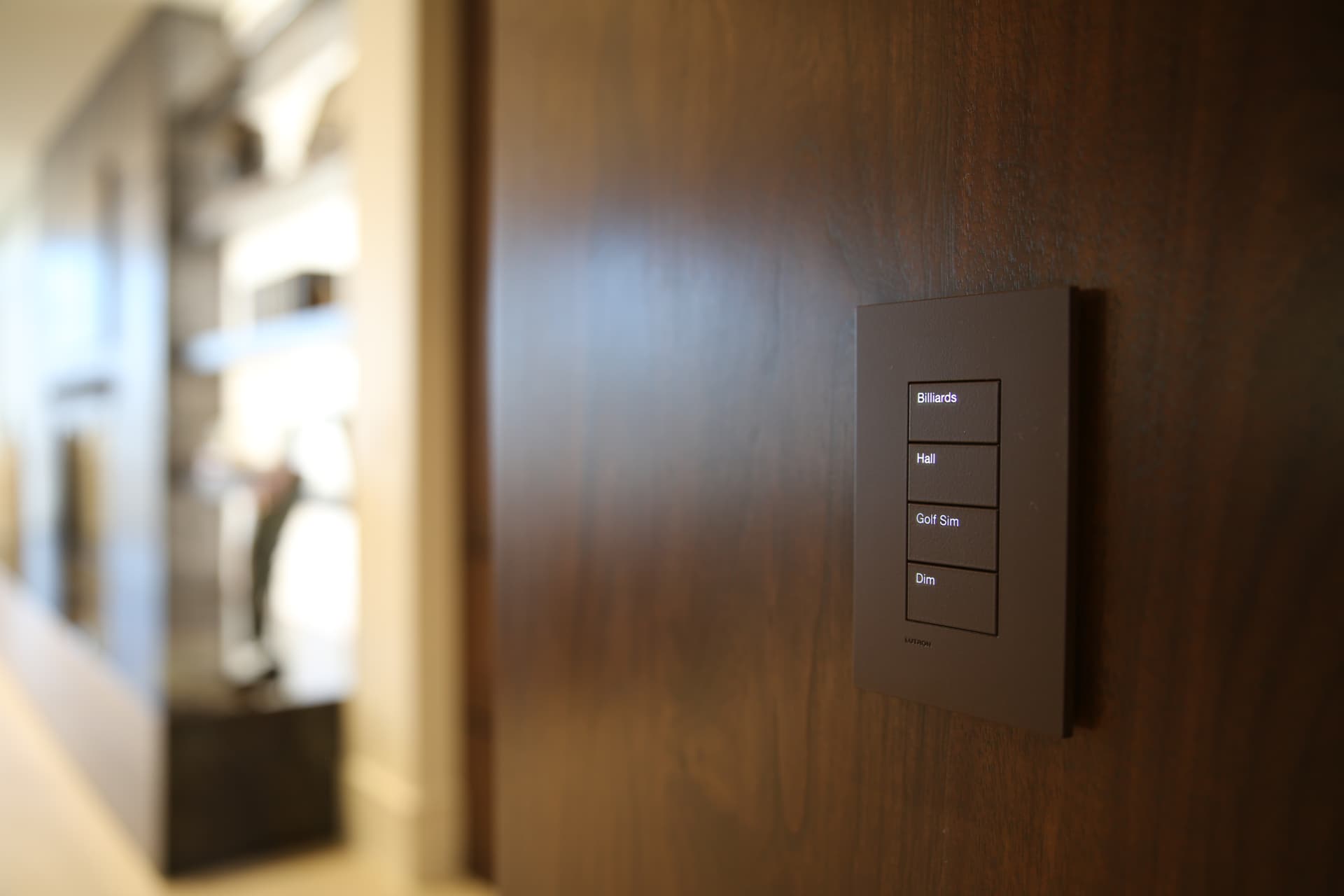
Rather than controlling every light individually, different lighting conditions can be programmed as scenes.
A daytime scene might use cooler, brighter illumination and rely more heavily on natural light.
An evening scene could lower the room's general lighting, warm the color temperature and bring the artwork forward.
An entertaining scene might increase the art lighting slightly while dimming other architectural fixtures.
A late-night scene could reduce everything to comfortable navigation lighting.
With advanced tunable fixtures, a scene can potentially control much more than brightness. It can coordinate intensity, color temperature and other characteristics of the light together. Current control technology can even produce gradual changes over extended periods, allowing interior lighting to follow the changing character of daylight.
One button can change the entire visual hierarchy of the room.
The Latest Trend: Lighting That Isn't Static
One of the biggest changes happening in luxury residential lighting is the move away from static light.
Historically, you picked a bulb:
2700K.
3000K.
Maybe 3500K.
And that was what you lived with.
Today's advanced lighting systems can provide tunable white, warm-dimming, full-spectrum color, extremely low-level dimming, spectral tuning and dynamic lighting that changes throughout the day.
Some current architectural lighting technology spans from very warm, candle-like light to cool daylight and can produce millions of colors. Certain systems can also customize color rendering to change the perceived vibrancy of objects and materials.
The trend is moving toward layered, dynamic lighting rather than rooms filled with identical downlights. A 2026 luxury residential lighting report found designers increasingly emphasizing tunable, full-spectrum lighting and planning lighting controls earlier in the design process.
For art collectors and designers, this is particularly exciting.
A painting doesn't have to look exactly the same at 10 a.m. as it does during a dinner party at 8 p.m. The lighting can respond to the room, the natural daylight and the way the homeowner wants to experience the space.
Plan Art Lighting Early
The best time to talk about art lighting isn't after the artwork has been hung.
It's during design.
When we know where important artwork, sculpture or collections are going, we can coordinate fixture locations, beam angles, control zones and electrical requirements before the ceilings and walls are finished.
That conversation is especially important when a designer already knows the client's major pieces or has planned specific locations for art.
And when the collection isn't finalized yet? We can design flexibility into the system.
Because the goal isn't simply to illuminate a wall.
It's to create a room where the architecture, interiors, artwork and light all work together.
Have a project where art is an important part of the design? Bring us into the lighting conversation early. Precision Media Solutions works alongside designers, architects, builders and electrical partners to help make sure the technology supports the design from the beginning.